Work a nursing shift in about twenty minutes.
Take report on four or five patients, decide who to see first, and work the hall: assessments, meds, calls to the provider. Patients change based on what you do and what you miss. At the end you see what happened to each of them, and why.
Why I made this
I'm Nick, a registered nurse. I got my MSN at Johns Hopkins and have worked inpatient psych at Johns Hopkins Hospital and in the Bay Area.
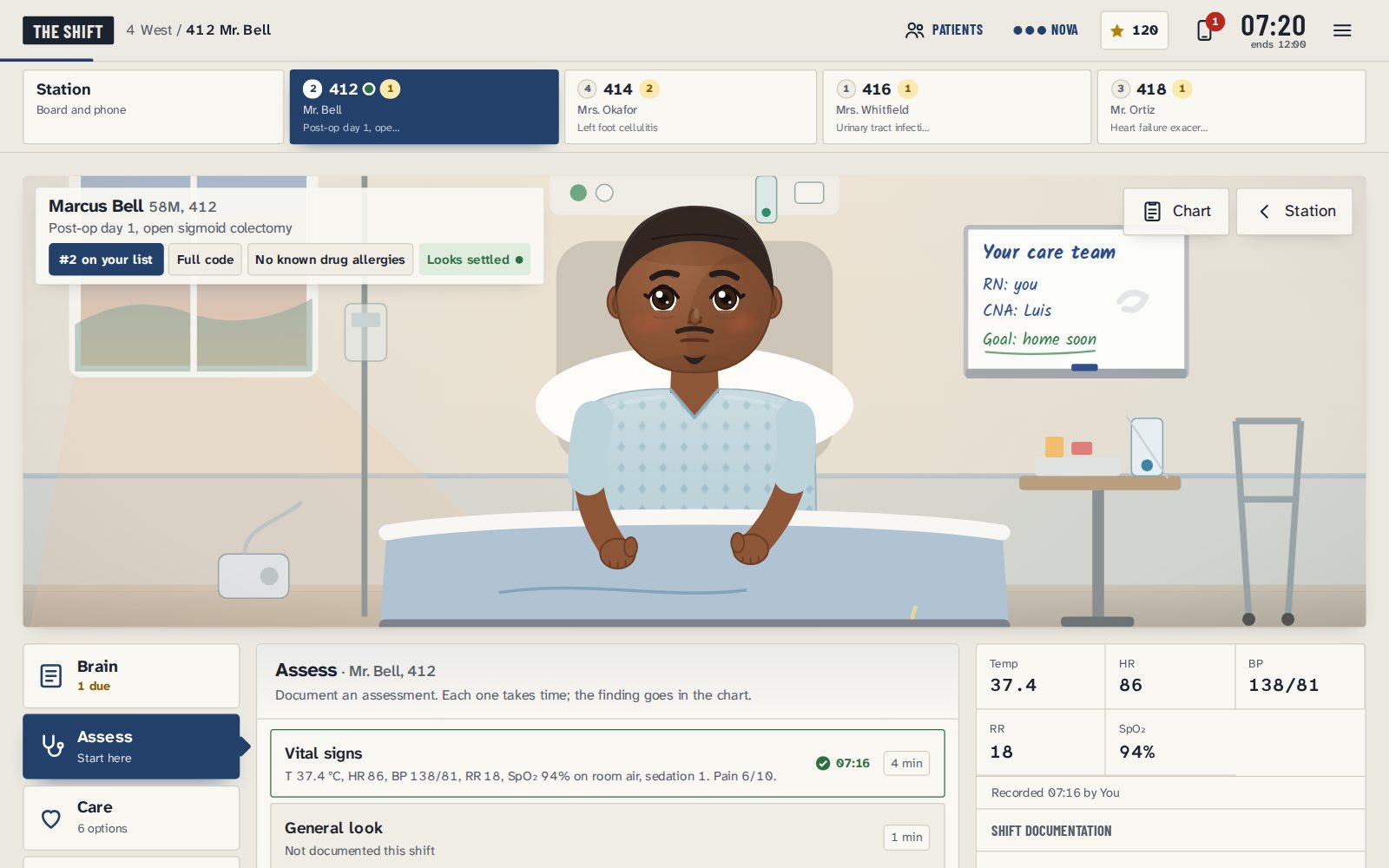
The Shift is practice for what a real assignment feels like: report from a tired night nurse, more patients than time, a phone that keeps buzzing, and one patient who is sicker than they look. The patients are made up. The situations are the ones that actually go wrong on a unit.
It's in beta. If something is clinically off, every decision in the debrief has a link to tell me, and I read all of them.
Nick
RN, MSN

How a shift goes
The clock only moves when you act. Every assessment, med pass and phone call costs minutes, and your other patients keep changing while you're busy.
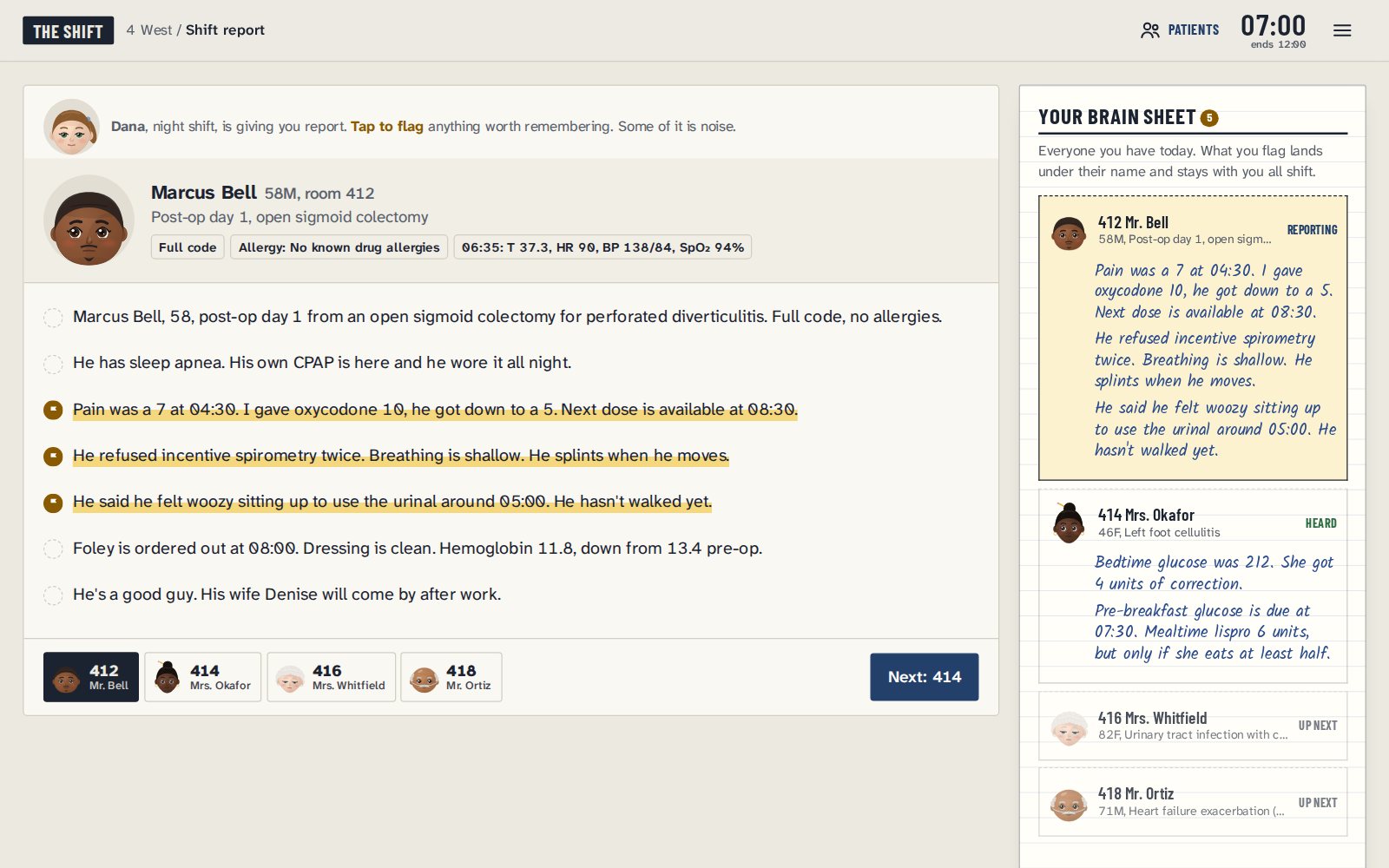
Take report
The off-going nurse talks through every patient. Flag what matters onto your brain sheet. Some of what you hear is noise.
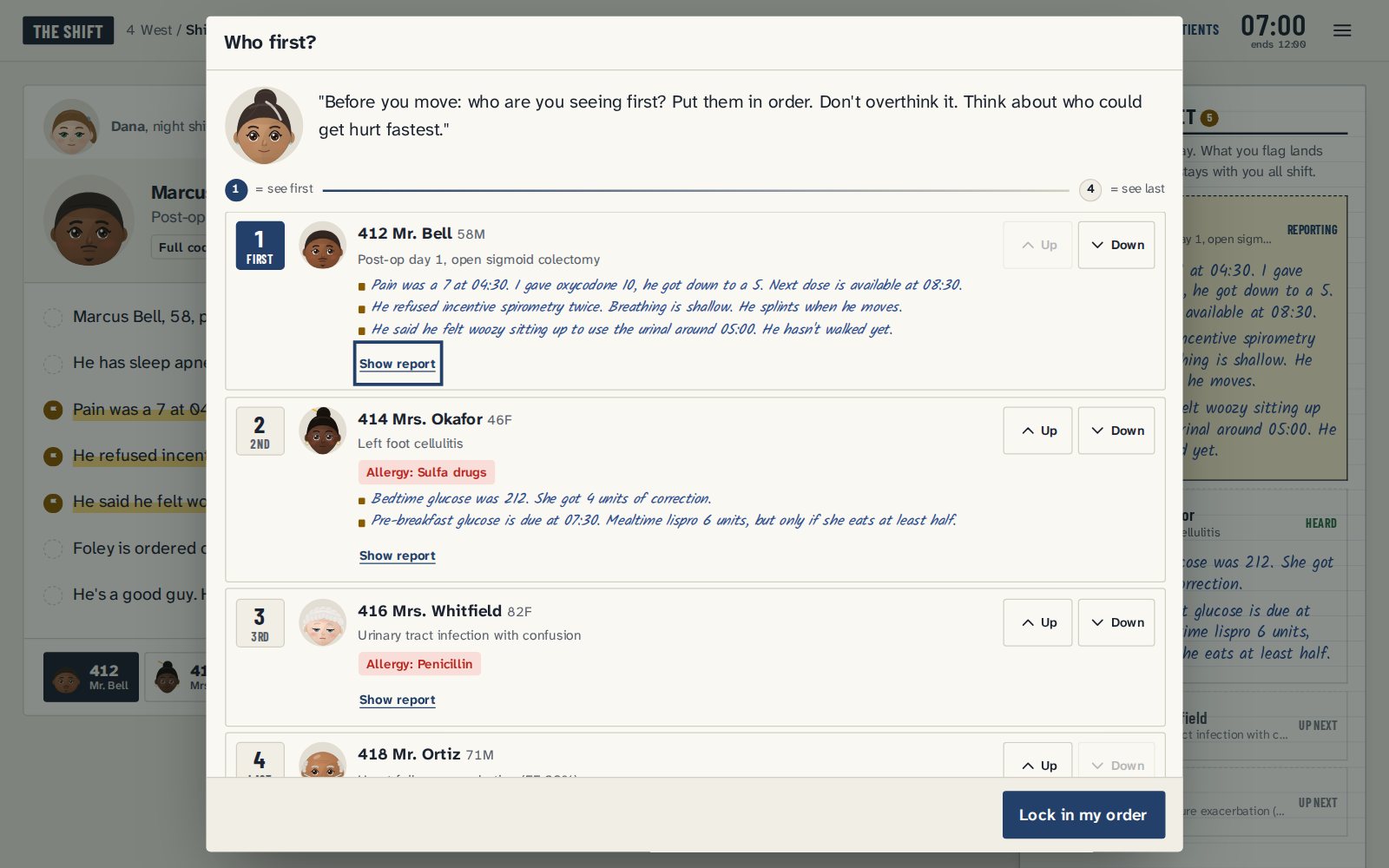
Decide who's first
Rank your patients before you move. Nova, the charge nurse, compares your order with hers and tells you why at the end.
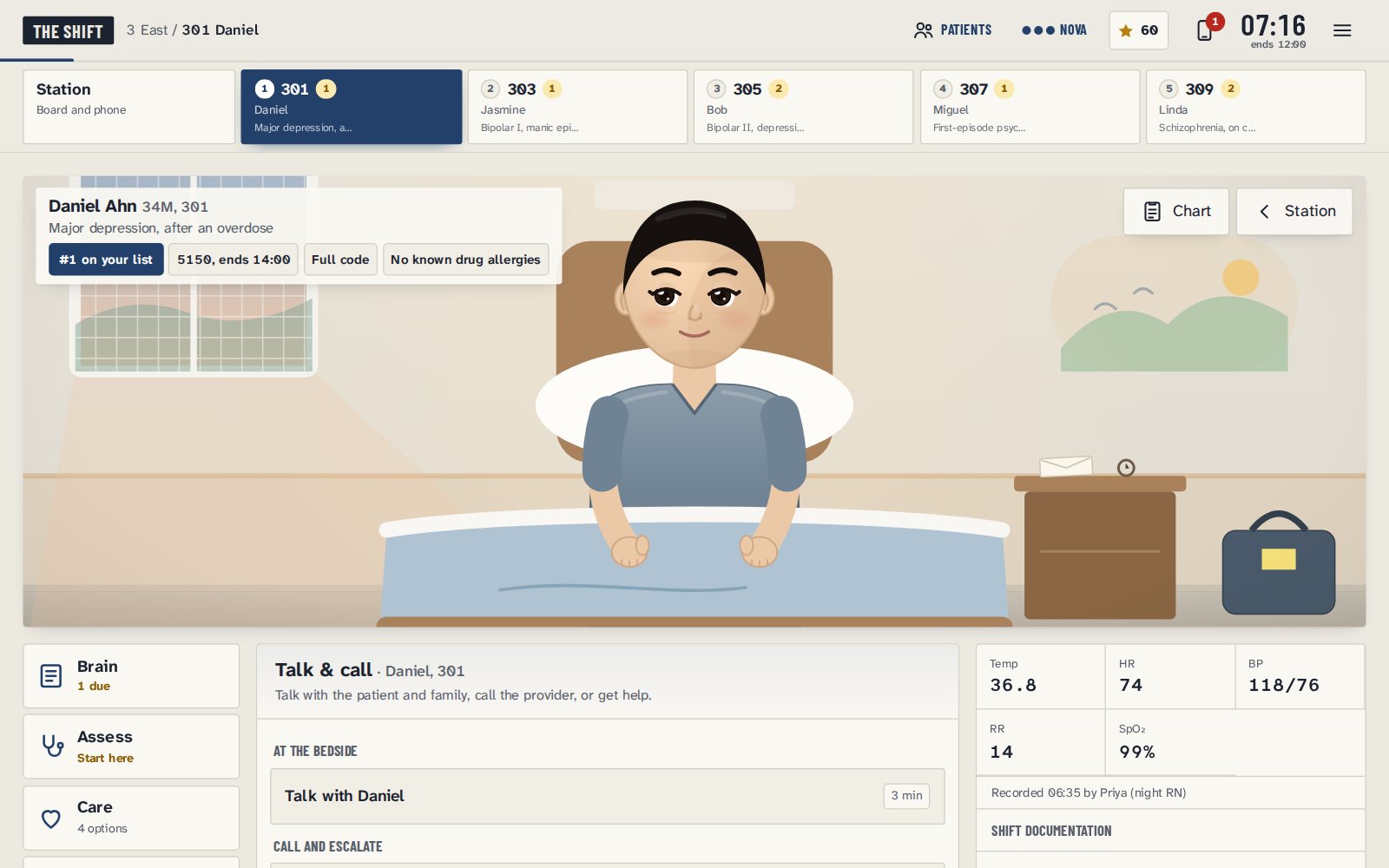
Work the hall
Assess, give or hold meds, delegate to your aide, talk with patients and families, and call the provider with SBAR. Look around the room; the clues are in it.
See what happened
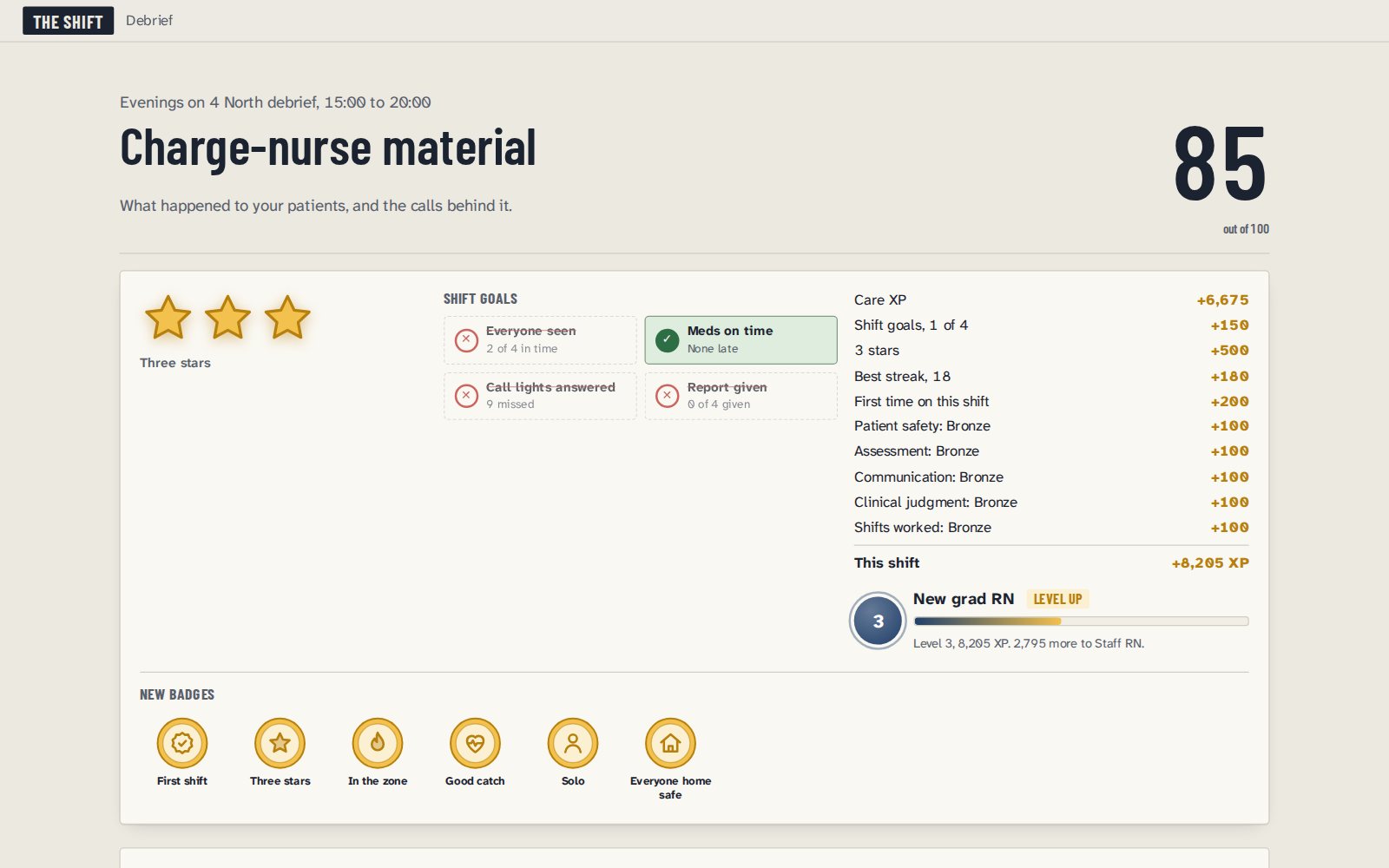
An outcome for every patient, the decision that mattered most, and each call you made with the reasoning behind it, scored by skill and by NCLEX clinical judgment step.
Eleven shifts so far
Start on days and work up to nights, step-down, the ICU, the ED, labor and delivery, mother-baby, psych and pediatrics. Then practice for the NCLEX with unfolding case studies and a question bank.
Four med-surg patients: a fresh post-op, a diabetic with cellulitis, a confused 82-year-old, and heart failure. Start here.
Four patients and an ED admission: COPD, alcohol withdrawal, a GI bleed getting blood, and a critical potassium.
Five patients, and your aide gets floated at 01:00. Delirium, a swollen calf, a DKA drip, a late stroke, and a PCA.
Cardiac step-down: a diltiazem drip and a bad echo, a fresh stent, a heparin drip with falling platelets, and a long QT.
Critical care: septic shock on a vasopressor in the wrong vein, a ventilator alarm, a chest tube that goes quiet after bypass surgery, and a family meeting about stopping life support.
Emergency, Pod B: a stroke alert with the wrong onset time, "indigestion" that becomes a STEMI, a positive pregnancy test with shoulder pain, and two more through the doors.
Labor and delivery: tachysystole on an oxytocin order that says go up, epidural hypotension, a uterine rupture during a trial of labor after cesarean, fever in labor, and a baby who arrives before the doctor does.
Mother-baby: a soft uterus behind a full bladder, magnesium that isn't clearing, a sleepy baby of a diabetic mother, and a depression screen nobody discussed.
Adult locked psych: mania, lithium toxicity, a med refusal, compulsive water drinking, and a man who is suddenly calm.
Adolescent psych: refeeding labs, self-harm precautions, a dystonic reaction, a disclosure, and an ED admission.
Pediatrics, four months to fifteen years: RSV on high flow, a sickle cell crisis, a dosing error, bruises that don't fit the story, and asthma.
What it practices
The clinical judgment the Next Generation NCLEX tests: noticing cues, prioritizing, acting, and checking whether it worked.
- You choose what to look at. There are no multiple-choice questions during the shift. You decide what to assess, in what order, and what to do about it.
- Mistakes play out. Give the wrong med and the patient reacts. Hold the right one and the debrief explains why it mattered.
- The traps are real ones. An order that's active but unsafe. A helpful family member. A report that says "probably a stomach bug."
- A charge nurse who helps a little. Nova gives a few hints a shift. She'll point you somewhere; she won't do it for you.
Play a shift, then tell me what broke.
Anything that felt clinically off, confusing, or too easy. Every decision in the debrief has a Report a problem link. Your progress saves in your browser as you play.